

Medicare has one period every fall when people who already have this health insurance can change how they will receive coverage the following year. For 2026, that period begins on October 15 and ends on December 7. The selected coverage begins on January 1, 2027.
During Medicare Open Enrollment, you can change your Medicare Advantage plan or switch to Original Medicare. You can also change your Part D drug plan. Federal rules provide the same annual period for Medicare beneficiaries across the United States.
Before we get to what makes sense to check this year, it is useful to explain what Medicare actually calls a “plan” here.
Medicare Is a Federal Program, and Part of the Coverage Is Offered by Private Insurance Companies

Medicare is a U.S. federal health insurance program primarily intended for people age 65 and older. The program also covers certain younger people with disabilities. Special rules exist for people with ESRD or ALS.
The program has existed since 1965. Congress passed the Social Security Amendments of 1965, and President Lyndon B. Johnson signed the law on July 30 of that year. Medicare today is administered by the Centers for Medicare & Medicaid Services, CMS, a federal agency within the Department of Health and Human Services.
When you get Medicare, there are two main ways to organize your coverage.
Original Medicare is administered by the federal government. Part A covers hospital care, while Part B covers a large share of physician and outpatient services. A separate Part D plan can be added for prescription drugs.
Medicare Advantage, also known as Part C, works differently. A private insurance company contracts with the Medicare program and offers its own plan. Such a plan includes Part A and Part B. Most also include Part D.
That is why the word plan appears so often in Medicare articles. A plan is a specific coverage package from a private insurance company that Medicare has approved. The plan sets its own premium and provider network within federal rules. A Part D plan also determines the list of covered drugs.
A private company can change the price of its plan for the following year. It can also change the terms of coverage. The federal system therefore gives beneficiaries a period each fall to make a new choice.
Why the Period Runs Specifically From October 15 to December 7
The period is often called the Annual Election Period, abbreviated AEP. The name Medicare Open Enrollment appears more often on Medicare.gov and in communication with beneficiaries.
Why does the choice happen in the fall? Plans already have their terms for the next calendar year. A beneficiary can look at the options for 2027 and make a decision before the new year begins.
CMS released information about 2027 plans ahead of the Open Enrollment period. Medicare beneficiaries can compare available options by ZIP code through the official Medicare Plan Finder system.
Here Is What You Can Actually Change During Medicare Open Enrollment
Once we know what a plan represents, the choices become much clearer:
- If you have Medicare Advantage, you can choose another Medicare Advantage plan.
- If you have Original Medicare, you can switch to Medicare Advantage.
- If you have Medicare Advantage, you can return to Original Medicare.
- If you use a separate Part D plan, you can choose another drug plan.
Medicare also allows you to add or drop Part D coverage in situations that meet program rules. A change selected by December 7 begins January 1, 2027.
Returning from Medicare Advantage to Original Medicare during the fall Open Enrollment period does not automatically guarantee the right to buy a Medigap policy without medical underwriting.
The separate six-month Medigap Open Enrollment period generally starts the first month you are 65 or older and enrolled in Part B; other guaranteed-issue rights and state protections may apply.
An important distinction: Medicare Open Enrollment is for people who already have Medicare and are changing how their coverage works. Initial Medicare enrollment has separate deadlines.
If You Already Have a Plan, First Look at the Document It Sent You

If you already have a Medicare Advantage or Part D plan, start with its Annual Notice of Change. The document identifies changes that may affect your coverage next year.
It is a document your current plan sends every fall. Medicare states that the ANOC arrives during September and shows changes that take effect in January.
For coverage that begins in 2027, we recommend five checks before you choose a plan:
- Prescription drugs: Check the formulary and the costs for every medicine you take.
- Pharmacy: Check the network status of your preferred pharmacy and its prescription prices.
- Doctors: Confirm that your primary care doctor and specialists accept the plan.
- Hospitals: Check the hospital network for facilities you expect to use.
- Total annual costs: Add premiums, deductibles, copays and coinsurance, and check the applicable out-of-pocket limit.
Suppose you paid a certain specialist copay during 2026. The ANOC can show a new price for 2027. A Part D plan can show a new premium or different coverage for your drug.
The plan name alone does not tell you what you will pay next year. Check the new premium, drug list, provider network, and copayments.
Such examples for 2027 are already appearing on a Medicare forum. One user with an Aetna Medicare Advantage PPO plan said that his premium remains $0, while the specialist copay rises from $45 to $50. The cost of certain laboratory services rises from $5 to $15. That is the experience of one person with one plan, so it serves as an illustration of why the ANOC document should be checked.
Part D Has New Federal Amounts for 2027
Part D covers prescription drugs. The plans are sold by private insurance companies that have contracts with the Medicare program.
The price and list of covered drugs differ among plans.
For 2027, CMS has already published several important figures.
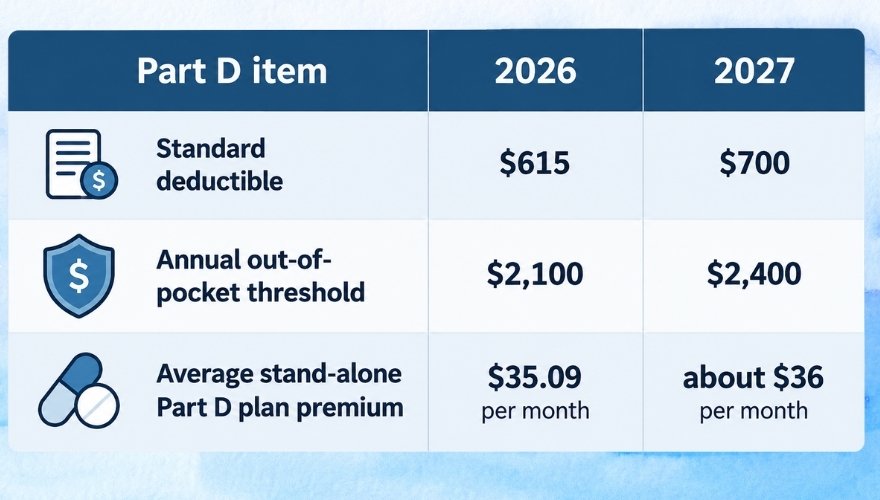
What Happens If You Change Nothing
If your current Medicare Advantage or Part D plan continues to exist during 2027, coverage generally continues under the terms for the new year. That is exactly why the ANOC has such an important role.
Suppose the premium stays the same. Your drug can move into another coverage category. With a Medicare Advantage plan, the copay for a service you use often can change.
We would treat automatic renewal as a choice worth reviewing. The plan may continue, but its terms can change.
CMS directs Medicare beneficiaries each year to review their current coverage and options for the following year during the Open Enrollment period.
What If You Miss December 7?

For most of the changes described here, December 7 is the end of the annual Medicare Open Enrollment period.
There is another period from January 1 through March 31, known as the Medicare Advantage Open Enrollment Period. It is intended for people who already have Medicare Advantage at that time.
During that period, a beneficiary can switch once to another Medicare Advantage plan. A beneficiary can also return to Original Medicare, with the option to enroll in a separate Part D plan.
A person who already has Original Medicare with a stand-alone Part D plan on January 1 follows different rules. A later change may be possible through a Special Enrollment Period when a certain life event occurs, such as moving or a change in other health coverage.
One Final Thought!
If you live mainly on Social Security, an increase in the Medicare premium goes directly into the same monthly budget. We explain the relationship between benefit increases and retiree expenses in our separate Social Security COLA analysis.
If those medical bills put pressure on your budget, Senior Benefits by Need explains which assistance programs may reduce some of the costs.
Our main advice is to use the annual enrollment period to review the coverage you will have in 2027. Compare the actual terms before December 7.